
Batch Coding Machine Buyer's Guide: 5 Types Compared (Real Prices)
A no-nonsense comparison of five batch coding machine types, handheld TIJ, semi-auto TIJ, thermal transfer, industrial CIJ, and laser, with real price ranges and a 3-year cost framework. Most small and medium operations don't need a $15,000 production-line printer. This guide shows you how to match machine type to your daily output, surface materials, and changeover frequency so you don't overspend.
Image Gallery
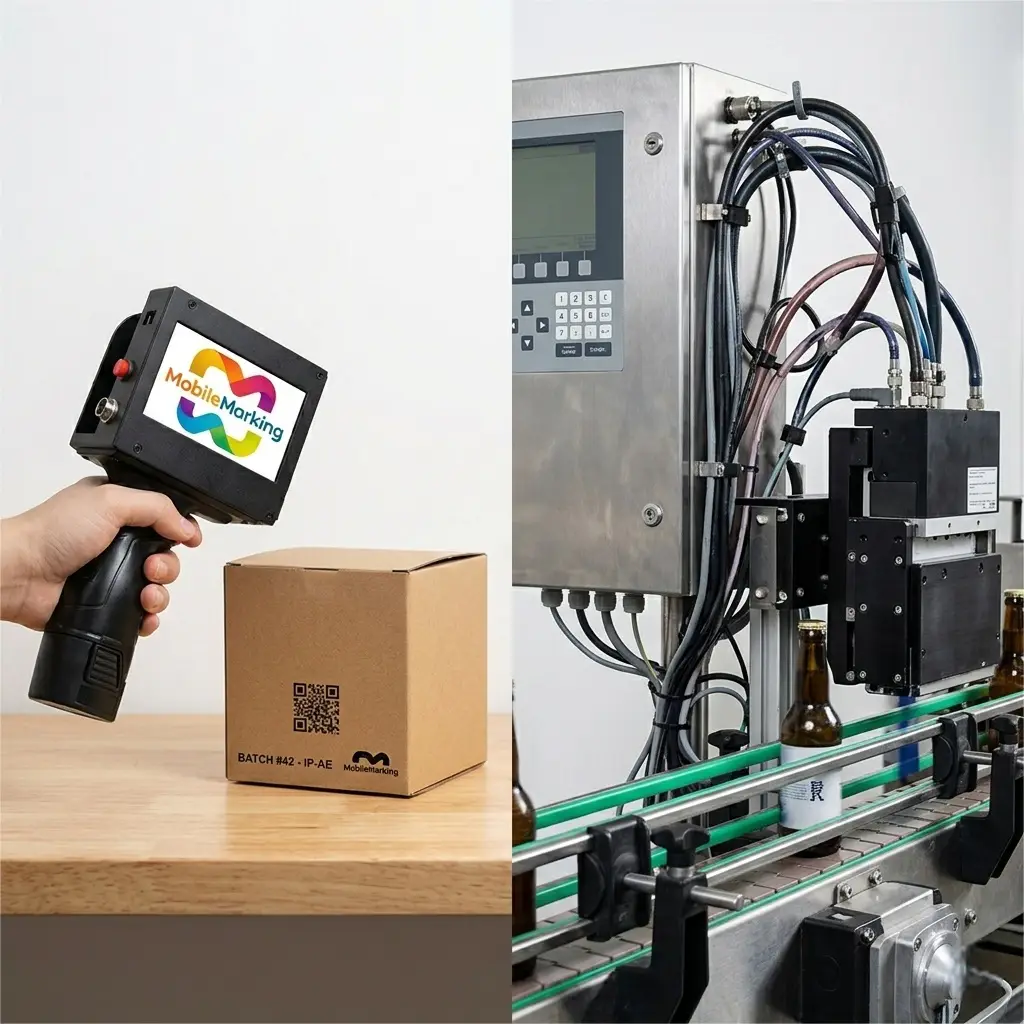
A brewery bought a used industrial inkjet printer for their bottling line. The machine worked fine. But the ink cartridges had RFID expiry chips, after 12 months, the printer refused to use them, regardless of how much ink was left. The brewery only ran one batch per week. They used maybe 10% of each cartridge before the chip forced a replacement.
That printer turned every cartridge into a subscription.
Batch coding machines range from $300 handheld printers to $80,000 laser systems. The expensive part isn't always the machine, it's the consumables, the maintenance contract, and the downtime you didn't budget for. This guide compares five types with real price ranges, no "contact us for a quote" evasions.
Key Takeaways
- Most small-to-medium operations (under 5,000 units per day) are better served by a handheld TIJ printer than an industrial CIJ or laser system
- The purchase price is the wrong number, maintenance contracts on industrial machines routinely cost more than the machine itself within 2-3 years
- Handheld TIJ printers range from roughly $200 to $4,000 for industrial-grade models; semi-auto coders from $700 to $4,300; industrial CIJ systems start around $4,500 and often exceed $50,000
- Cartridge encryption, where the printer refuses third-party ink, is a hidden cost factor that no competitor's buyer guide mentions
What Is a Batch Coding Machine?
A batch coding machine prints identifying information directly onto products or packaging. The information typically includes lot numbers, production dates, expiration dates, serial numbers, and barcodes.
If you manufacture, package, or distribute physical products, you almost certainly need batch coding. The regulatory drivers vary by industry. Pharmaceutical manufacturers must comply with 21 CFR Part 211.188, which requires batch production and control records for every drug batch (source). Food producers face FDA traceability requirements under FSMA 204, which mandates that traceability records be provided within 24 hours upon request, the compliance date has been extended to July 2028. GS1 barcode standards define batch/lot numbers under Application Identifier 10 (source).
But here's what most guides skip: the regulatory requirement is often just "put a legible code on it." Nobody mandates that you spend $50,000 on a laser system to do it. A handheld inkjet printer meets traceability requirements for the vast majority of small and medium operations.
Five Types of Batch Coding Machines, What They Actually Cost
Most "batch coding machine" content on Google is written by industrial equipment manufacturers. They default to production-line CIJ and laser narratives because that is what they sell. Handheld TIJ printers are nearly invisible in editorial buyer guides, despite covering a large chunk of real-world use cases.
Here is what each type actually costs, based on publicly verifiable prices rather than quote forms.
Handheld TIJ Printers
Price range: roughly $200 to $4,000 for commercial/industrial-grade units
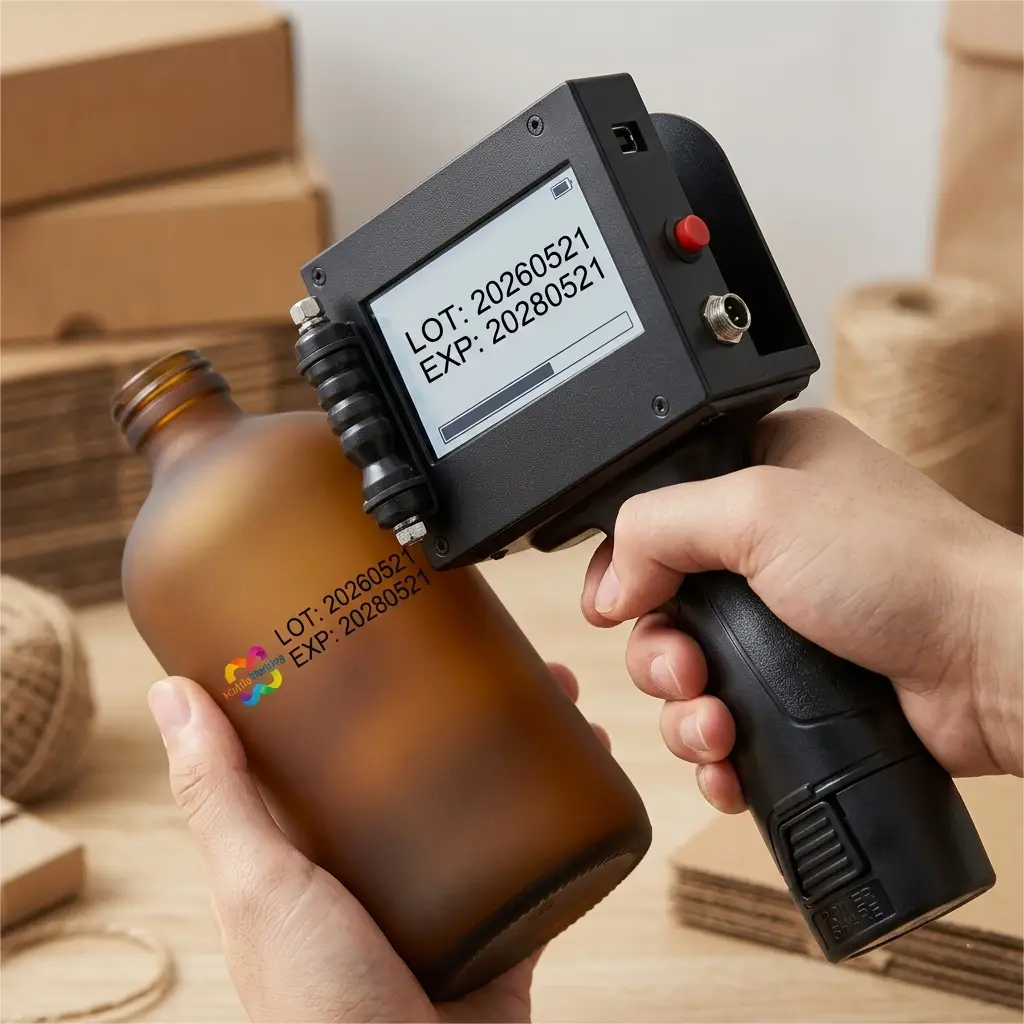
Handheld thermal inkjet (TIJ) printers use disposable or refillable cartridges. You hold the printer, position it over the surface, and pull the trigger or tap the screen. No conveyor required.
Specs: Print heights from 12.7 mm (0.5 inches) to 50.8 mm (2 inches) for dual-head models. Resolution typically 300 to 600 DPI. Cartridge capacities range from roughly 42 ml for solvent-based inks. One 42 ml cartridge can produce tens of thousands of prints before replacement.
Best for: Operations producing up to a few thousand units per day, especially those running multiple SKUs with frequent batch changes. A craft brewery bottling 500 cans per batch, a supplement co-packer running 10 different formulas per shift, a building materials supplier marking plywood grades, all are textbook handheld TIJ applications.
Pros: No service contract. No installation. Cartridge swap takes 10 seconds. Switch print content from a touchscreen in under a minute. Most models weigh under 1 kg.
Cons: Manual operation. Print speed depends on the operator. Not suitable for lines running thousands of units per hour.
Product examples from our lineup:
- Model 127A, entry-level, 600 DPI, 12.7 mm print height, Type-C charging, ideal for small-batch date and lot coding
- Model 1680, metal body, conveyor-ready with photoelectric trigger, bridges the gap between handheld and semi-automatic
Semi-Automatic TIJ and Thermal Transfer Overprinters
Price range: $700 to $4,300
These are fixed-position machines. The printhead mounts on a bracket or stand. Product feeds past, either by hand, on a simple roller conveyor, or integrated into a form-fill-seal machine.
Semi-auto TIJ uses the same cartridge technology as handheld printers but in a stationary setup. HeatSign HS-1050 ($860) and similar inline TIJ printers work well for a dedicated packing station where someone feeds boxes or pouches past the printhead.
Thermal transfer overprinters (TTO) use heated ribbons instead of liquid ink. They are the standard choice for flexible packaging films, snack bags, pouches, shrink wrap. The ribbon transfers code onto the film surface. TTO machines like the Videojet 6530 can hit speeds up to 700 packs per minute, making them viable for mid-volume automated lines.
Best for: Fixed packing stations with steady throughput. TTO specifically for flexible film packaging.
Pros: Faster and more consistent than handheld. No operator fatigue on long runs.
Cons: Fixed position limits flexibility. TTO requires ribbon management. Most semi-auto systems use proprietary consumables with chip locks.
Industrial Continuous Inkjet (CIJ)
Price range: $4,500 to $50,000+ (most brands quote-only)
CIJ printers are the workhorses of high-speed production lines. They work by pumping electrically charged ink through a microscopic nozzle, deflecting droplets to form characters on a moving surface. We've toured plants running these machines — they're impressive, but they're also fussy. Speeds reach 278 meters per minute with up to 5 lines of text.
These are the machines made by industry giants, Videojet, Domino, Hitachi, and others. Almost none publish prices publicly. Based on third-party seller listings and used equipment markets, new CIJ units start around $4,500 and climb rapidly.
Best for: Continuous high-speed lines running 10,000+ units per day of the same or similar products.
Pros: Fastest print speed. Print on nearly any material. Multi-line capability.
Cons: The hidden costs. This matters enough to deserve its own section.
Industrial Laser Coders
Price range: $15,000 to $80,000+ (almost entirely quote-only)
Laser coders etch marks directly into surfaces using CO2, fiber, or UV lasers. No ink. No ribbon. No consumables at all. Domino launched the Ux360i UV laser coder in 2026, targeting GS1-compliant 2D codes on mono-plastic packaging with marking speeds up to 80% faster than previous generation.
Best for: Permanent marking on high-speed lines where eliminating consumables justifies the upfront cost. Beverage, pharma, and electronics industries.
Pros: Zero consumables. Permanent marks. Minimal maintenance. High speed.
Cons: Extreme upfront cost. Requires safety enclosures and extraction. Overkill for operations that just need to print a date and lot number on a cardboard box.
If you are marking fewer than 10,000 units per day, you are paying for speed you will never use.
Quick Comparison: All 5 Types at a Glance
The Hidden Cost Trap: Why the Purchase Price Lies
A white paper from coding equipment manufacturer Diagraph breaks CIJ hidden costs into five categories: printhead cleanings, service downtime, consumables, skilled labor, and changeover time (source). These add up fast.
Here is what actual users report. On an industrial maintenance forum, a user shared that their CIJ printer cost nearly twice the original purchase price just in maintenance over its lifespan. Another reported spending $2,200 per month on a service contract, and still waiting 2 to 4 days for a technician to show up when the machine went down.
Then there is the consumable lock-in problem. Some CIJ printers use RFID-tagged ink and makeup cartridges with expiration dates hardcoded into the chip. After the expiry date passes, the printer refuses to use the cartridge, even if it is still 90% full. One brewery owner reported exactly this: their printer forced them to discard most of their ink every year because the RFID timer expired long before the ink ran out.
A service contract that costs more per year than the printer did to buy is not a maintenance plan. It is a lease you didn't know you signed.
Small manufacturers hit hardest by these costs often realize, too late, that they bought a machine designed for three-shift automotive supplier lines, not their 500-bottle craft soda runs.
That's not to say CIJ is bad technology. It's excellent technology for the right scale. The problem is that nobody tells buyers where the scale threshold is.
The Cartridge Encryption Factor
Most discussions of batch coding machine costs ignore the cartridge encryption issue entirely. We covered this in detail in our guide to unencrypted ink cartridges, but here is the short version:
Some handheld TIJ printers accept any compatible cartridge. Others use crypto chips that lock you into buying the manufacturer's own cartridges, at 2-3x the price. Before buying any printer, flip the cartridge over and look for a metal rectangle on the bottom. If you see one, that printer has an encrypted cartridge system. You will be paying the manufacturer's price for ink for the life of the machine.
This is the single most important question to ask a sales rep, and almost no batch coding machine buyer guide mentions it.
How to Choose: A Decision Framework Based on Your Operation
Most guides list features. This one starts with your production reality because the machine that works for a factory running 100,000 units per shift is almost certainly wrong for a co-packer running 500 units of 15 different products.
Step 1: What is your daily output?
- Under 2,000 units per day: Handheld TIJ. Do not overthink this. A $300-500 printer with a $25 cartridge swap every few months is the right tool. Our portable coder lineup covers this range.
- 2,000 to 10,000 units per day: Handheld TIJ or semi-automatic TIJ, depending on whether you have a fixed packing station. The Model 1680 with its conveyor-ready trigger sits right at this boundary.
Step 2: How often do you change what you print?
This is the question nobody asks and it might matter more than daily volume.
A nutraceutical co-packer running 10 different client formulas per day changes print content 10 times. On an industrial CIJ, each changeover might mean purging ink lines, cleaning printheads, and recalibrating, 20 to 30 minutes per change. Ten changes eats half the shift.
On a handheld TIJ printer, you select a saved template from the touchscreen and keep printing. Changeover time: under 30 seconds.
If you change print content more than 3 times per day, a handheld printer's changeover speed alone can justify it over a CIJ.
Step 3: What surface are you printing on?
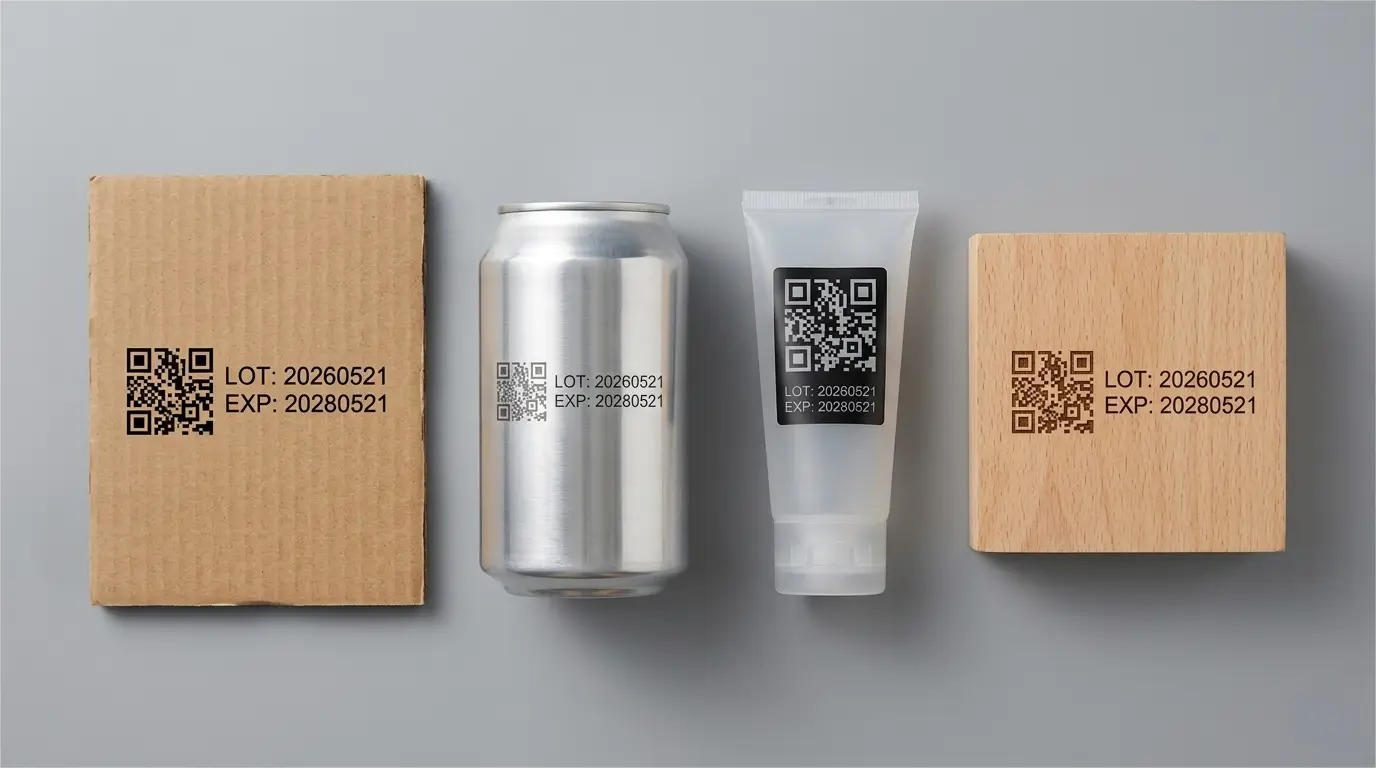
- Cardboard, unpainted wood, uncoated paper: Nearly any ink works. Standard solvent cartridges from our supplies page handle these easily.
- Glass, metal, glossy plastic: These are non-porous surfaces. Ink sits on top rather than absorbing in, making adhesion the primary challenge. Solvent-based inks perform best here, but always test on your specific material. We have seen cases where labels printed on non-porous plastic rubbed off within hours with the wrong ink formulation.
- Flexible film (snack bags, shrink wrap): This is TTO territory. Thermal transfer bonds the code to the film surface. TIJ can work but verify adhesion with your specific film type.
Step 4: What is your actual budget, including year two?
A $15,000 CIJ with a $3,000 annual service contract costs $21,000 over three years, before ink. Two handheld TIJ printers (one primary, one backup) at $400 each, with $300 per year in cartridges, cost roughly $1,700 over three years. That is a 12x difference for an operation where both produce compliant, legible batch codes.
The global coding and marking equipment market is projected to grow from $17.5 billion to $24.9 billion by 2030 (source). A lot of that growth comes from small and medium manufacturers being sold equipment scaled for Fortune 500 production lines. Do not be part of that statistic.
Material Quick Reference: What Prints on What
Different surfaces demand different inks and technologies. We've tested every combination below in our own shop — here's what actually works:
A material test costs you one cartridge and 10 minutes. Buying the wrong printer for your surface costs thousands. Test first.
The Bottom Line
If you walk away from this guide with one sentence, make it this: most operations producing fewer than 5,000 units per day do not need an industrial batch coding machine.
The batch coding machine market has a scale mismatch problem. Equipment manufacturers and their content marketing default to production-line solutions, CIJ, laser, thermal transfer, because those are the high-ticket items. Small manufacturers read those guides, assume they need industrial equipment, and overspend by a factor of 10 or more.
A handheld TIJ printer prints dates, lot codes, batch numbers, barcodes, and QR codes on nearly any surface. It costs a few hundred dollars, uses cartridges you can buy anywhere, and requires no service contract. For the craft brewery, the supplement co-packer, the building materials yard, the small-batch cosmetics lab, it is not the "budget option." It is the right tool.
Browse our handheld batch coding printers to compare models, or contact our team if you want a recommendation based on your specific material and volume.
For a deeper look at how industrial production-line coders compare, see our industrial CIJ printer overview. And if cartridge costs are a concern; they should be, read our guide to unencrypted ink cartridges before talking to any sales rep.
Frequently Asked Questions
Can a handheld printer really do batch coding?
Yes. A handheld TIJ printer prints lot numbers, expiration dates, production dates, barcodes, QR codes, serial numbers, and multi-line text. The print quality at 600 DPI matches or exceeds many entry-level industrial coders. The difference is speed; a handheld printer is operator-paced (roughly 30-60 prints per minute) while a CIJ runs continuously at line speed.
What is the cheapest batch coding machine?
For commercial-grade equipment, handheld TIJ printers start around $200-300. If you find one under $50, it is almost certainly a toy-grade device with poor print quality and no solvent ink compatibility. At the other end, industrial-grade handheld printers with metal bodies, wider print heads, and advanced features run $2,000-4,000. The sweet spot for most small businesses is $300-500.
Do I need a service contract for a batch coding machine?
For handheld TIJ printers: no. The only consumable is the ink cartridge. When a cartridge runs out, you snap in a new one. There are no ink lines to clean, no pumps to maintain, no printheads to replace. For industrial CIJ and laser systems: yes, service contracts are standard and should be priced into your purchase decision from day one.
What is the difference between TIJ and CIJ?
TIJ (thermal inkjet) uses disposable cartridges with built-in printheads. Ink is heated to create a bubble that forces a droplet onto the surface. CIJ (continuous inkjet) pumps a continuous stream of electrically charged ink through a nozzle, deflecting droplets to form characters. TIJ is simpler, lower-maintenance, and cartridge-based. CIJ is faster, more complex, and requires ongoing maintenance including solvent replenishment and line cleaning. For production under 5,000 units per day, TIJ is almost always the more practical choice.