
What Is an Unencrypted Ink Cartridge? How Cartridge Authentication Works and What It Costs
An unencrypted ink cartridge has no crypto chip, so your printer fires regardless of brand. This guide explains how cartridge authentication works in the handheld inkjet printer industry, which brands require branded cartridges and which don't, how to check your printer in 30 seconds, and what the real cost difference is over time.
Image Gallery

Introduction
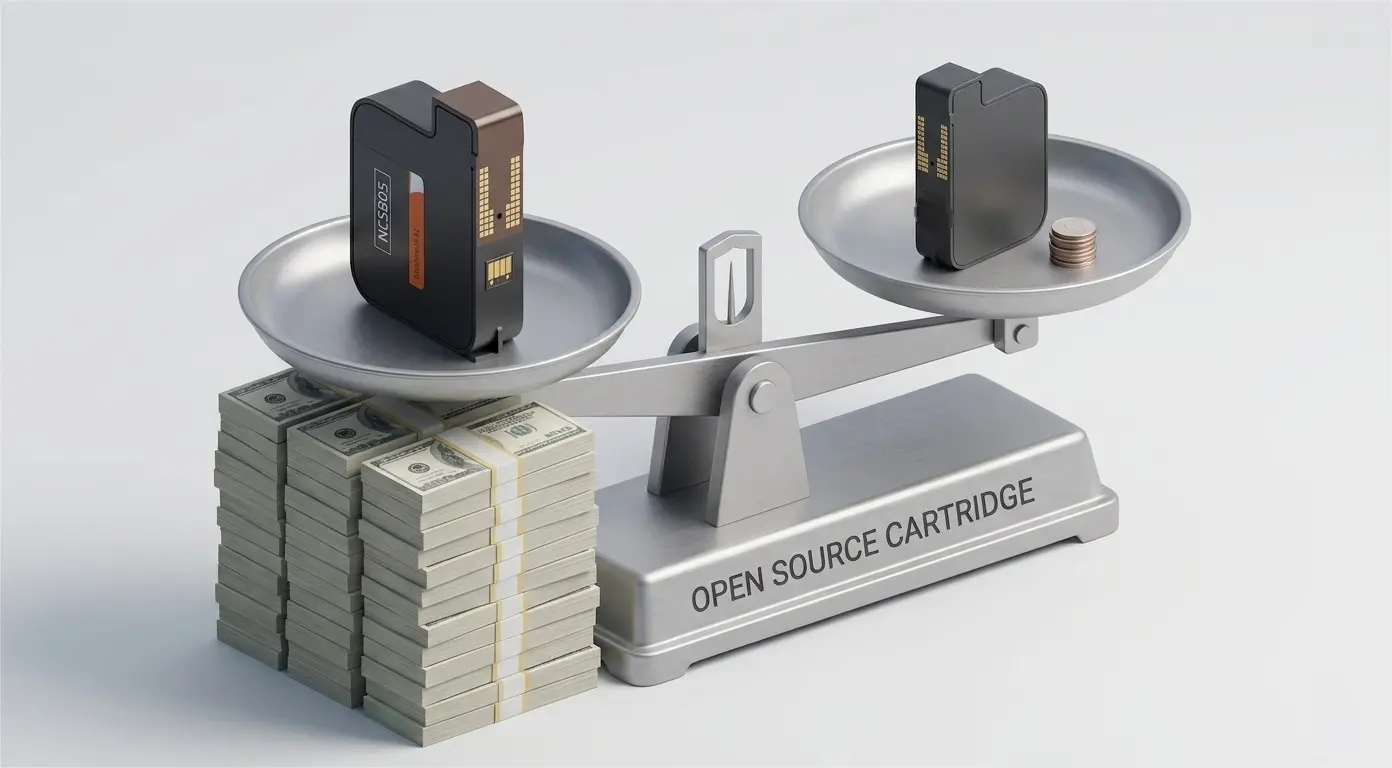
An unencrypted ink cartridge has no crypto chip embedded in the plastic. The printer fires regardless of brand. An encrypted cartridge has a chip that forces the printer to verify the brand before it will print a single dot. Same ink, same shell, same printhead. The difference is a piece of silicon that costs pennies to make and adds $30 to $100 to every cartridge you will ever buy.
In 2022, Canon proved this chip has nothing to do with print quality. A global semiconductor shortage meant Canon could not get the DRM chips for its imageRUNNER toner cartridges. Rather than halt production, Canon shipped the cartridges without chips. Then it published official instructions showing customers exactly how to dismiss the printer's own DRM warnings. Canon's support page confirmed there are "no negative effects on print quality when consumables are used without electronic components."
The admission was striking. The company that built the authentication system confirmed, in its own support documentation, that removing the chip had no effect on print output. Critics point to this as evidence that cartridge authentication functions primarily as a supply-control mechanism rather than a quality safeguard. Canon ended the chipless shipments after the shortage resolved and removed the bypass instructions from its site. But the documents remain public record.
Cartridge authentication is now standard across the handheld inkjet printer industry. This article explains how it works, which brands use it, how to check if a given printer requires branded cartridges, and what the cost difference looks like over 5 years. If you are new to handheld inkjet printers, start with our complete guide to handheld inkjet printers for the fundamentals.
Key Takeaways
- An unencrypted ink cartridge has no crypto chip: the printer fires with any compatible cartridge. An encrypted cartridge checks for a brand-specific chip and refuses to print if it is missing.
- Canon publicly admitted in 2022 that DRM chips have zero effect on print quality, when it shipped chipless toner and told customers how to bypass its own warnings.
- Handheld TIJ brands that encrypt their cartridges include Bentsai, UPRINTJET, Videojet/Wolke, and Domino. Brands that use unencrypted cartridges can be identified by their cartridge model numbers — if a printer accepts 2580, 2588, T1704K, JS12, or FOL13B cartridges, it is unencrypted.
How Printer Cartridge Encryption Works
The authentication system has three layers.
The Chip
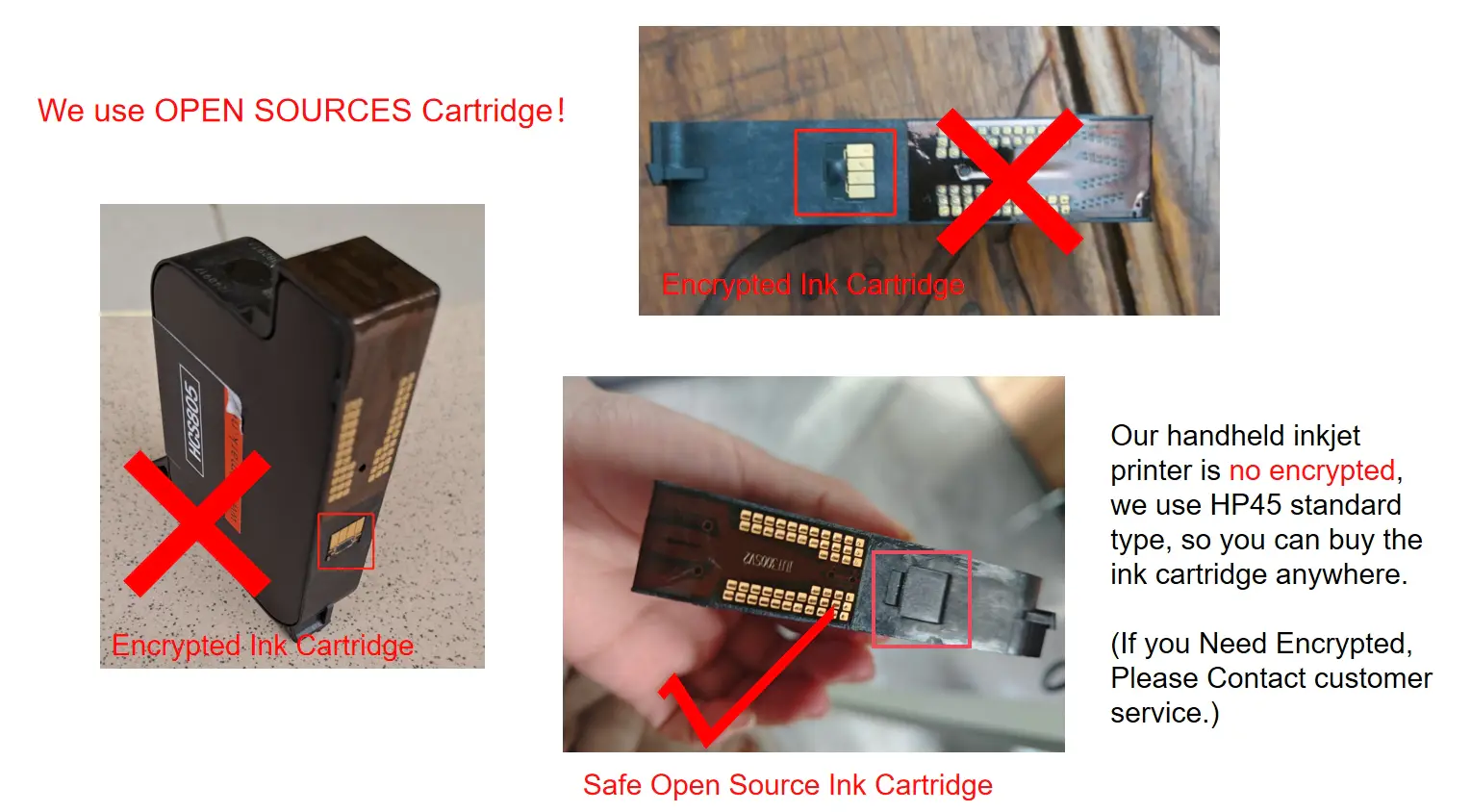
Flip over an encrypted ink cartridge and you will see a small metallic rectangle embedded in the plastic, usually near the electrical contacts. That is a cryptographic chip. It stores a unique identifier, a brand certificate, and sometimes a page counter or expiration date.
When you insert the cartridge into the printer, the chip makes contact with a reader inside the cartridge slot. Before the printer will fire the printhead, it reads the chip and runs a cryptographic handshake. If the chip returns the correct brand certificate, the printer activates. If the chip is missing, expired, or from the wrong brand, the printer refuses to fire. It does not matter that the cartridge is physically identical and full of perfectly good ink.
The Firmware
The chip is only half the story. The printer's firmware is the other half. Firmware updates can change the rules after you have already bought the printer. A printer that accepted third-party cartridges on day one can start rejecting them after a firmware update on day 400.
This is exactly what happened with HP's "Dynamic Security" feature starting in 2016. HP pushed firmware updates that retroactively blocked non-HP cartridges that had worked fine for months. The same firmware architecture exists in handheld TIJ printers. Brands can push updates that tighten the encryption check without telling you.
The Economics
The cartridge authentication model creates a razor-and-blade business structure:
- Sell the printer at a competitive price, sometimes near cost.
- Require brand-authenticated cartridges via the crypto chip.
- Generate recurring revenue from cartridge sales at significantly higher margins.
A $139 handheld printer might generate $7,800 in cartridge revenue over 5 years. The long-term cost sits in the cartridges, not the printer.
Why Manufacturers Use Authentication
Printer manufacturers give several reasons for cartridge authentication. Understanding their position makes the cost comparison more useful.
Quality assurance. Branded cartridges are tested to work with the specific printhead voltage, ink viscosity, and nozzle geometry of a given printer model. A manufacturer has no control over the formulation inside a third-party cartridge, and a badly made cartridge can clog nozzles or leak solvent into the electronics.
Counterfeit prevention. Crypto chips make it harder to sell fake cartridges under a brand's name. This is a legitimate concern on platforms where counterfeit industrial consumables are common.
R&D cost recovery. Thermal inkjet printheads and quick-dry solvent formulations take years of engineering to develop. The cartridge revenue model funds that R&D. Without recurring cartridge sales, the economics of developing new printer models would need to shift to higher upfront hardware prices.
The counterargument. Critics note that Canon's own 2022 documentation confirmed that chipless toner cartridges caused "no negative effects on print quality." They also point to the EU Joint Research Centre's 2024 Ecodesign study, which identifies cartridge chips as a designed-in barrier to reuse and recommends mandatory chip resetting. The debate is ongoing, and regulators in the EU are actively examining the practice.
Where you land on this spectrum is less important than knowing which side a given printer falls on before you buy. The rest of this article gives you the tools to find out.
See how much unencrypted cartridges cost →
Desktop Printers Wrote the Playbook. Handheld Printers Copied It.
The desktop printer industry has spent two decades perfecting cartridge DRM. The handheld TIJ industry is now applying the same tactics, but with much higher stakes because the volumes and the dollars are larger.
HP: The $4.1 Million Precedent
HP's Dynamic Security firmware updates have resulted in multiple legal payouts:
- $1.5 million to settle a 2018 California class action.
- $1.35 million to EU customers in 2022.
- €10 million fine from the Italian Antitrust Authority in 2020.
- ~AUD $50 per customer payouts in Australia in 2018.
In March 2025, a US federal judge approved another HP settlement covering Dynamic Security firmware updates that disabled third-party cartridge compatibility on certain LaserJet models. HP funded a $1.5 million reimbursement pool and was barred from reinstalling Dynamic Security on the covered models. For most other HP printers, Dynamic Security remains active, and HP advises that future firmware updates may affect cartridge compatibility.
Brother 2025: The Friendly Brand Falls
Brother built its reputation on being the brand that did not pull this stuff. Users on Reddit and the Better Business Bureau have documented Brother printers refusing or degrading third-party cartridges after forced firmware updates that cannot be rolled back. Brother denies the allegations, but the law firm Migliaccio & Rathod LLP has opened an active investigation into both HP and Brother.
One Reddit user summed it up: "That's a bummer. Literally the one thing I gave Brother credit for was that they seemed to be better about third party ink than HP."
The pattern is familiar: a brand builds market share with an open consumable policy, then introduces authentication requirements once its installed base reaches critical mass. This happened with HP's desktop printers, is currently alleged against Brother, and the same model now appears across the handheld TIJ industry.
The Canon Smoking Gun
This is the single most important data point in the entire cartridge encryption debate.
During the 2022 global chip shortage, Canon could not source the DRM chips for its imageRUNNER toner cartridges. Rather than stop production, Canon shipped cartridges without the chips and published official instructions explaining how customers could dismiss the printer's DRM warning and continue printing. The instructions explicitly confirmed that using cartridges without chips causes no damage to the printer and no degradation in print quality.
Critics of cartridge authentication point to this episode as strong evidence that crypto chips serve a supply-control function rather than a print-quality one. Canon's own documentation confirmed that genuine cartridges without authentication chips performed identically. The company that built the authentication system documented, in its own support materials, that the chip was not required for proper operation.
After the chip shortage ended, Canon resumed shipping cartridges with authentication chips and removed the bypass instructions from its support site. The documents remain archived and publicly accessible.
Which Handheld Printer Brands Lock You In
We cross-referenced official product listings, manufacturer PDFs, Amazon listings, AliExpress seller disclosures, and Reddit user reports to build the first public encryption matrix for handheld TIJ printers.
Encrypted Brands
How to Spot an Unencrypted Printer
You do not need a brand list. You need to know the cartridge model number.
Unencrypted handheld printers use standard, openly manufactured cartridge form factors. The most common ones for 12.7mm print height are 2580, 2588, T1704K, FOL13B, and JS12. Compatible variants exist for 25.4mm and 50mm formats. If a printer accepts one of these cartridge models, it is unencrypted. Multiple manufacturers produce these cartridges, so you are never locked to a single supplier.
MobileMarking printers fall into this category. Our cartridges use no crypto chip and ship at roughly $50 including international shipping. Because the cartridge format is open, you can also use compatible cartridges from any other supplier that manufactures to the same standard.
We ran the 30-second functional test on six handheld printer models across both encrypted and unencrypted systems. On every unencrypted model, the counter incremented cleanly with no cartridge inserted. On every encrypted model, the counter stayed frozen until a branded chip was detected. The test is definitive.
The encryption problem is widespread enough that online sellers now preemptively warn buyers. Listings for standard unencrypted cartridges routinely include disclaimers like: "Important: This cartridge does not contain an encryption chip. Unencrypted printers use this cartridge. If it is an encryption printer, it cannot be used." The fact that sellers feel the need to add this warning tells you everything about the state of the market.
Browse unencrypted handheld printers →
How to Check If Your Handheld Printer Is Encrypted (30 Seconds)
You do not need to open the printer. You do not need technical knowledge. There are two checks, and either one gives you the answer.
Visual Check
- Remove the ink cartridge from the printer.
- Flip it over and look at the bottom surface.
- If you see a small metallic rectangle embedded in the plastic, the cartridge is encrypted. If the bottom is clean plastic with only the ink nozzle and electrical contacts visible, the cartridge is unencrypted.
Functional Check
This test works even if you cannot visually identify the chip:
- Remove the ink cartridge from the printer.
- Turn the printer on.
- Aim the printer at the air and pull the trigger.
- Watch the counter on the screen.
If the counter number increases, the printer does not check for a chip. Your printer is unencrypted. You can buy cartridges from any supplier. If the counter stays frozen, the printer is checking for a chip that is not there. Your printer is encrypted.
Run this test before you buy a new handheld printer. Ask the vendor to confirm in writing whether their cartridges use encryption. If they will not answer directly, run the test on a demo unit. If they will not provide a demo unit, buy from someone who will.
The Real Cost of Encrypted Cartridges
Most people compare printer prices. They should be comparing cartridge prices. The math is not close.
The Baseline
A small production line printing batch codes and expiry dates on 500 boxes per day burns through roughly one 42ml solvent cartridge every 13 working days, about 12 cartridges per year. A typical date code runs 15 characters. A standard cartridge prints about 100,000 characters before the ink runs out.
The 5-Year Numbers
The gap between a Bentsai encrypted printer and a MobileMarking unencrypted printer over 5 years is $4,800. That buys six additional printers, or a lot of other things your business actually needs.
Even comparing the mid-range scenarios, an unencrypted printer with new original cartridges at $50 each saves nearly $2,000 over 5 years compared to an encrypted printer with $80 cartridges.
Cartridge encryption isn't just a printer problem — it's a batch coding machine selection problem. Our batch coding machine buyer's guide includes encryption as a line item in the 3-year total cost comparison, something no other buyer's guide covers.
The Price-Quality Spectrum
Because unencrypted cartridges follow open form factors, they are manufactured at multiple price points. At the low end, you can find cartridges in the $15-$35 range from various online sources. Quality is inconsistent. We ordered test batches of 2588 cartridges from five different suppliers and ran each through a production simulator printing date codes on corrugated boxes. Two batches printed cleanly through 80,000+ characters. One batch started skipping at 40,000. One leaked solvent on arrival. One printed fine but the ink dried noticeably slower, about 8 seconds versus the standard 3-5.
If you have a testing environment or your marking requirements are low-stakes (internal warehouse labels, temporary codes), the budget-tier cartridges might work. Order a small batch first and test before committing to bulk. For active production lines where a bad cartridge means downtime and scrapped product, the risk of a leaking or skipping cartridge usually outweighs the per-unit savings.
New-manufacture unencrypted cartridges with consistent quality control, like the ones MobileMarking sells at $50 including international shipping, sit at the reliable end of the spectrum. Same open format, no crypto chip, but built to consistent spec by a known manufacturer. You keep the freedom to buy from anyone without the $80+ encryption tax that Bentsai and other locked brands charge. Different price points for different risk tolerances — the open cartridge model gives you that choice. Encrypted systems take it away.
Is This Legal? The Regulatory Landscape
Cartridge encryption exists in a gray area that regulators are starting to close. The trend is toward requiring open consumable ecosystems, but the speed depends on where you are.
European Union: The Strongest Protections
The EU is moving fastest. The Right to Repair Directive (adopted June 13, 2024, in force July 30, 2024) extends consumer repair rights to imaging equipment, including printers, under separate ecodesign rules. Member states must transpose the directive into national law within 24 months.
The European Commission's Joint Research Centre (JRC), the EU's in-house science service, published an Ecodesign Preparatory Study in February 2024 that explicitly identifies cartridge chips as a "designed-in technical barrier to reuse." The study recommends mandatory chip resetting, physical accessibility to cartridge chips, and requiring remanufacturing-relevant information to be stored inside the chip itself.
This study underpins the EU's 2024 Ecodesign for Sustainable Products Regulation. While the regulation does not ban cartridge chips outright, it creates the legal framework for doing so in future implementing acts.
United States: State-by-State Patchwork
There is no federal right-to-repair law in the US yet. New York, California, and Minnesota have passed right-to-repair legislation, but printer consumables are not always covered. The FTC has historically intervened in cartridge-related market abuses: in 2002, it fined two online cartridge sellers $40,000 for misrepresenting remanufactured cartridges as new brand-name products. It remains the only federal enforcement action in this specific market.
The HP class-action settlements show that US courts are willing to constrain cartridge DRM when it is challenged by well-funded plaintiffs. But individual small businesses have little recourse. The practical protection is to buy unencrypted equipment from the start.
What This Means for Buyers
If you operate in the EU, the regulatory direction is clear: cartridge encryption is under sustained legal pressure, and open consumable standards are likely coming. If you operate in the US, the legal safety net is thinner — your strongest protection is choosing unencrypted hardware at the time of purchase. Once you are inside an encrypted ecosystem, switching costs are high, and the law will not help you much.
What to Ask Before Buying a Handheld Printer
Five questions to put to any vendor before you hand over your money:
If you are not sure which printer fits your operation, contact us with your material and volume details. We will recommend the right model and ink combination.
Summary
Cartridge authentication in handheld inkjet printers follows the razor-and-blade business model the desktop printer industry has used for decades: sell the hardware at a competitive price, generate recurring revenue from consumables. Canon's 2022 chipless toner episode, where the company confirmed no print quality impact from removing authentication chips, is frequently cited by critics who argue that crypto chips function primarily as a supply-control mechanism.
Encrypted handheld TIJ brands include Bentsai, UPRINTJET, Videojet/Wolke, and Domino. Unencrypted printers accept standard cartridge form factors — 2580, 2588, JS12, T1704K, and FOL13B — that any manufacturer can produce. If your printer takes one of these cartridge models, it is unencrypted.
You can check any handheld printer for encryption in 30 seconds: remove the cartridge, look at the bottom for a metallic chip. No chip means unencrypted. Alternatively, fire the trigger without a cartridge installed. If the counter moves, the printer is open.
The 5-year cost difference between encrypted and unencrypted cartridges exceeds $4,800 for a typical small production line consuming 12 cartridges per year. The printer is not the expensive part. The cartridges are.
EU regulators are actively examining cartridge authentication through the Right to Repair Directive and the JRC Ecodesign study, which identifies cartridge chips as designed-in barriers to reuse and recommends mandatory chip resetting. US protections are less developed, making the initial purchase decision the most important factor in determining long-term cartridge costs.
Frequently Asked Questions
What is an unencrypted ink cartridge?
An unencrypted ink cartridge has no cryptographic chip. The printer fires with any compatible cartridge regardless of brand. There is no handshake, no brand verification, and no firmware check before the printhead activates. Unencrypted cartridges follow standard form factors (2580, 2588, T1704K, JS12, FOL13B for 12.7mm) that multiple manufacturers produce.
How do I tell if my handheld inkjet printer is encrypted?
Two methods. Visual: flip the cartridge over and look for a metallic chip on the bottom. If the bottom is clean plastic, it is unencrypted. Functional: remove the cartridge, turn on the printer, fire the trigger in the air. If the counter on the screen increases, the printer is unencrypted. If the counter stays frozen, it is encrypted.
Which handheld printer brands use unencrypted cartridges?
The easiest way is to check the cartridge model. If a printer uses 2580, 2588, T1704K, FOL13B, or JS12 cartridges (for 12.7mm print height), it is unencrypted. These are standard open form factors produced by multiple manufacturers. MobileMarking printers fall into this category. If a printer uses a proprietary cartridge part number sold by only one company, and the cartridge has a visible metal chip on the bottom, it is almost certainly encrypted.
How much does a handheld inkjet printer cartridge cost?
Unencrypted cartridges span a wide range. Budget-tier open-format cartridges run $15-$35 but quality varies significantly between suppliers. Quality-controlled new-manufacture unencrypted cartridges, like those from MobileMarking, are around $50 including international shipping. Encrypted brand cartridges run $80 to $130+ per cartridge. The price spread within the unencrypted market reflects differences in manufacturing quality and quality control. The price gap between unencrypted and encrypted cartridges reflects the brand premium charged in single-supplier systems.
Will using third-party cartridges void my printer warranty?
In the United States, the Magnuson-Moss Warranty Act generally prohibits manufacturers from voiding warranties solely because you used third-party consumables. In practice, encrypted printers enforce the lock technically rather than through warranty terms: the printer simply refuses to fire with a non-brand cartridge, regardless of your legal rights. This is why the encryption status of the printer matters more than the warranty language.
Is the EU requiring printer makers to remove cartridge DRM?
Not yet, but the path is being laid. The EU Right to Repair Directive (adopted June 2024) extends consumer repair rights to imaging equipment. The EU Joint Research Centre's 2024 Ecodesign study explicitly identifies cartridge chips as designed-in barriers to reuse and recommends mandatory chip resetting and accessibility. These are the preparatory steps for future regulation that could require open cartridge standards.