
The Complete Guide to Handheld Inkjet Printers: Types, Costs, and How to Choose
A handheld inkjet printer with unencrypted cartridges saves $1,000-$3,600+ over three years compared to encrypted-brand printers. Entry-level TIJ models start at $139, handle virtually any surface (cardboard, metal, plastic, glass, wood, fabric, leather, cement), and avoid the $80+ cartridge lock-in that encrypted brands impose. Use 300 DPI for text, 600 DPI for barcodes. Under 5,000 items/day → handheld TIJ. Over 10,000/day → consider CIJ. Before buying, check for cartridge encryption: flip the cartridge over, a metal chip on the bottom means locked.
Video Demonstration
Image Gallery
Introduction
The best handheld inkjet printer for most businesses is a thermal inkjet (TIJ) model with unencrypted cartridges and adjustable 300-600 DPI resolution. It costs $139-$500, prints on virtually any surface, cardboard, metal, plastic, glass, wood, leather, aluminum, fabric, cement, and avoids the $80-per-cartridge lock-in that encrypted brands depend on.
Sarah runs a small hot sauce company in Austin. Last year she paid $2,400 for ink cartridges on a $300 printer. She didn't know her printer had a crypto chip inside that blocked third-party cartridges. She found out when she flipped the cartridge over, spotted the chip on the bottom, and realized why her $20 compatible cartridge was refused.
Most businesses overpay for product marking the same way Sarah did. They either burn labor hours on handwritten labels, or they drop $15,000 on an industrial CIJ line. A handheld inkjet printer sits in the middle, a few hundred dollars, one-hand operation, prints directly onto almost any surface.
But the market is opaque. Manufacturers bury the cartridge lock-in. Buying guides are written by printer brands pushing their own products and ignoring the competition. We compared five brands, did the math on three-year cartridge costs, and tested prints across multiple materials. Here is everything you need to choose the right printer, and avoid the trap Sarah walked into.
Key Takeaways
- A handheld inkjet printer with unencrypted cartridges saves $1,000-$3,000+ over three years compared to encrypted-brand printers, new unencrypted cartridges cost ~$50, encrypted cartridges cost $80+
- Quick-dry solvent ink handles virtually any surface (cardboard, plastic, metal, glass, wood, leather, fabric, cement, aluminum); it dries in 3-5 seconds and is permanent on porous materials
- Entry-level handheld printers start at $139; the real cost is in the cartridges, not the printer, and there are three cartridge types at three very different price points
What Is a Handheld Inkjet Printer?
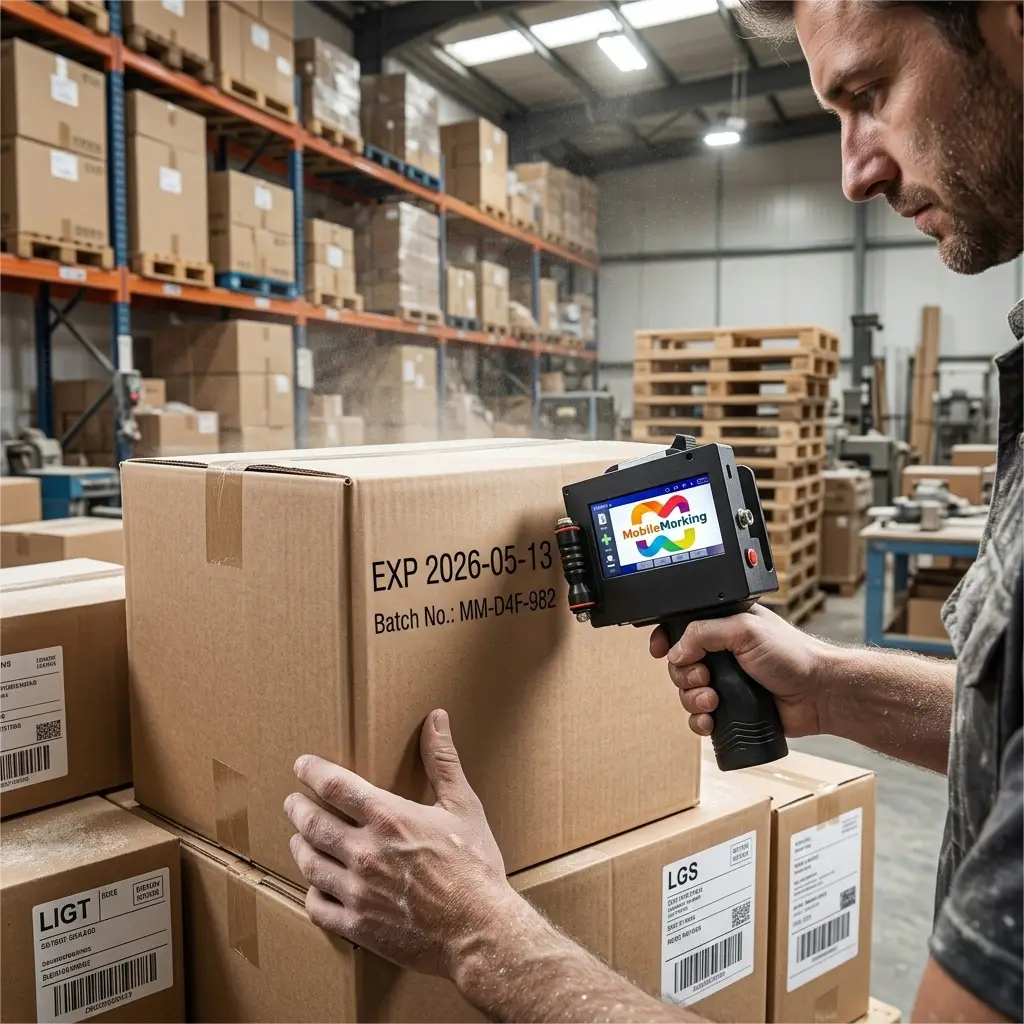
A portable handheld inkjet printer is a battery-powered device that prints text, dates, barcodes, QR codes, and logos directly onto physical surfaces. It does not print on paper. You hold it like a pistol grip, the form factor is often called a handheld inkjet printer gun, aim the nozzle at a box, bottle, pipe, or pallet, and pull the trigger. A quick-drying inkjet mark appears in under a second.
The core technology inside most handheld printers is Thermal Inkjet (TIJ). Tiny heating elements inside the printhead vaporize ink droplets and propel them through a nozzle onto the surface. This is one of the two dominant inkjet technologies alongside piezoelectric, used in industrial and commercial printing since the 1990s (see this technical review of inkjet printing technologies for a deeper explanation). The printhead moves across the surface manually (you move your hand), while the printer's internal timer and position sensor keep the print aligned.
Here is what separates a handheld inkjet printer from the printer on your desk:
A handheld printer typically stores hundreds of message templates in internal memory. You create the template on the 4.3-inch touchscreen or on a computer and transfer it via USB. Templates can include auto-incrementing serial numbers, real-time date and time stamps, barcodes (Code 128, QR, Data Matrix), and imported logo images in BMP format. For barcode applications, the industry is moving fast, GS1 has set a target for global retail POS scanners to read both linear and 2D barcodes by the end of 2027 (see GS1's 2D in Retail implementation guide).
See our full handheld printer lineup →
Common use cases:
- Manufacturing: Print batch numbers, production dates, and serial numbers on products and packaging
- Food and beverage: Expiry dates and lot codes on boxes, bottles, and pouches
- Warehousing: Carton marking, inventory labels, pallet IDs
- Construction: Mark pipes, cables, lumber, and sheet materials on site
- Pharmaceuticals: Compliance coding with variable data
Types of Handheld Inkjet Printers
Not all handheld printers use the same technology. The printhead type determines what materials you can print on, how fast the ink dries, and what the printer costs to maintain.
Thermal Inkjet (TIJ)
TIJ, handheld thermal inkjet printer technology, is the standard for nearly every handheld inkjet printer under $1,000. It uses heat to eject ink droplets through a precision nozzle. The printhead and ink cartridge are a single disposable unit, when the ink runs out, you replace the entire cartridge.
Best for: Cardboard, paper, wood, plastics, metal, glass, and general-purpose marking.
Resolution: Adjustable 300, 400, or 600 DPI. Sharp enough for barcodes and small text at 600 DPI.
Cost: Printers start at $139; replacement cartridges range from $20 (remanufactured) to $50 (new original) to $80+ (encrypted).
Maintenance: Virtually none. No pumps, no filters, no solvent flushing.
Piezoelectric
Piezoelectric printheads use mechanical vibration instead of heat to eject ink. This allows a wider range of ink chemistries, including UV-curable inks and aggressive solvent inks that would damage a TIJ heating element.
Best for: Glass, metal, ceramic, and glossy plastics where standard TIJ ink won't adhere.
Resolution: Comparable to TIJ (300-600 DPI).
Cost: Printers start at $800-$1,500. Cartridges are more expensive but last longer.
Maintenance: Periodic printhead cleaning required. More sensitive to dust and impact.
Continuous Inkjet (CIJ)
CIJ is the industrial workhorse. It pumps a continuous stream of ink through a nozzle, deflects droplets electrically to form characters, and recirculates unused ink. These are not truly handheld, they weigh 10-20 kg and are usually mounted on production lines.
Best for: High-speed production lines printing 100,000+ units per day.
Cost: $10,000-$50,000 upfront, plus $2,000-$5,000/year in consumables and maintenance.
Why it's mentioned here: Because many small businesses buy a CIJ without knowing a handheld TIJ printer would handle their volume just fine. The price difference is roughly 50x.
Quick Comparison
For 90% of businesses that need on-product marking, a TIJ handheld printer is the right tool. The rest of this guide focuses on TIJ handheld printers, what to look for, what to avoid, and how to compare models.
What Can You Print On? Materials and Surface Guide
The most common reason a handheld printer "doesn't work" is not a faulty printer, it's the wrong ink for the surface. Here is the good news: quick-dry solvent ink cartridges like the ones MobileMarking sells work on virtually any surface. Here is what you need to know about each material.
How Quick-Dry Solvent Ink Behaves
Quick-dry solvent ink is the Swiss Army knife of handheld printer inks. It adheres to almost everything, glass, plastic, wood, cloth, cement, fabric, metal, leather, aluminum, and dries in 3-5 seconds.
What matters is whether the mark needs to be permanent or removable:
- Permanent on porous surfaces: Paper, cardboard, wood, cloth, and fabric absorb the ink. The mark cannot be removed once dry.
- Removable on non-porous surfaces: On plastic and glass, the ink can be wiped off with alcohol. This is useful for temporary marking, but if you need a permanent mark on glass or glossy plastic, you may need a primer pre-treatment or UV-curable ink.
Cardboard and Corrugated Boxes
The easiest surface. Solvent ink soaks in and dries within seconds. The mark is permanent.
Print quality: Excellent. 300 DPI is sufficient for text and barcodes.
Plastic (Bottles, Bags, Containers, PVC Pipes)
Solvent ink adheres well to most plastics including HDPE, PET, and PVC. However, the mark sits on top of the surface (plastic is non-porous), so it can be removed with alcohol if needed. For glossy or smooth plastics, wipe the surface with alcohol before printing, invisible dust and grease will ruin adhesion.
Print quality: Good to excellent. 600 DPI recommended for small text on curved bottles.
Drying time: 3-5 seconds.
Metal (Pipes, Parts, Sheets, Cans, Aluminum)
Solvent ink bites into bare metal and forms a durable mechanical bond. Painted or powder-coated metal is even easier, the ink grips the coating surface. For aluminum, the mark is permanent on bare metal.
Print quality: Good on bare metal and aluminum, excellent on painted metal. 300-600 DPI.
Glass (Bottles, Jars, Vials)
Solvent ink prints on glass and dries quickly. The mark is removable with alcohol, good for temporary batch codes, but not for permanent labeling. For permanent glass marking, consider a CO2 laser engraver as a complement to your printer, or use a primer pre-treatment before printing.
Print quality: Adequate for batch codes and dates. Not suitable for decorative or branding-quality results (that requires screen printing or UV digital).
Wood (Crates, Pallets, Lumber)
Porous and forgiving. Ink soaks in and becomes permanent. Both water-based and solvent ink work.
Print quality: Good. 300 DPI sufficient.
Fabric, Leather, Cloth, Cement
Solvent ink handles these materials well:
- Fabric and cloth: Solvent ink marks are permanent after drying. Good for manufacturing tags and textile identification.
- Leather: Ink adheres well. Permanent on most leather types.
- Cement: Porous surface, ink soaks in and becomes permanent.
Material Compatibility Table
Key Specifications: How to Compare Models
When you compare handheld inkjet printer models side by side, focus on these six specs. Everything else is secondary.
1. Print Resolution (DPI)
MobileMarking handheld printers offer adjustable resolution: 300 DPI, 400 DPI, and 600 DPI. You choose the right setting for your print job:
- 300 DPI: Good enough for text, dates, and batch numbers 2mm and larger. Faster printing, uses less ink.
- 400 DPI: Balanced option. Sharper text, good for most barcodes.
- 600 DPI: Sharp enough for small scannable barcodes, small QR codes, and clean logo printing. Noticeably crisper text at any size.
- Our recommendation: If you print barcodes or small text, use 600 DPI. The flexibility to switch between resolutions means one printer handles everything from large carton labels to fine QR codes.
2. Print Height (mm)
This is the vertical height of a single line of text. Most handheld printers fall into three categories:
- 12.7mm (0.5 inch): Standard single-line height. Good for dates and short codes. Models: MobileMarking 127A, most entry-level printers.
- 25.4mm (1 inch): Wider format. Prints two lines of 12.7mm text, or one tall line. Models: MobileMarking 1691S.
- 50mm (2 inches): Wide format, typically dual-head. Prints four lines or large characters. Models: MobileMarking 16832.
3. Battery Life
- 5-8 hours: Standard for most budget and mid-range models. Enough for a shift.
- 10-12 hours: Found on premium models. Useful if the printer is used across multiple shifts or on job sites without easy charging.
- Swappable batteries: A few models let you hot-swap batteries. If you run continuous production, this matters.
4. Ink Cartridge Capacity and Type
A standard cartridge holds 42ml of ink and prints roughly 100,000 characters before needing replacement. More on cartridge cost below, this is the single most overlooked spec when comparing printers.
5. Touchscreen and Software
A 4.3-inch touchscreen is standard on current-generation models. Older or ultra-budget printers use button navigation and smaller LCDs. The touchscreen matters more than you'd think, creating and editing message templates on a tiny button-based screen takes three times as long.
Software features to look for:
- Message storage: Hundreds of templates stored in internal memory, accessible from the touchscreen.
- Auto-increment counters: Serial numbers that count up automatically.
- Date/time auto-insert: The printer stamps the current date and time without manual entry.
- Multi-language support: If you print in non-Latin scripts (Chinese, Arabic, etc.), verify support.
- Load logos and templates from a computer.
6. Build Quality and IP Rating
- Plastic body: Light, cheap, adequate for clean indoor environments. Not drop-rated.
- Metal body: Heavier, more durable, survives workshop and job-site use. Worth the premium if the printer moves between locations.
- IP rating: IP54 means dust-protected and splash-resistant. If you print in dusty, wet, or outdoor environments, look for this.
MobileMarking Model Comparison
Ink Cartridges: The Cost No One Talks About
The purchase price of the printer is the smallest number on the invoice. The ink cartridges are where you spend the real money, and where most manufacturers make their profit.
Three Types of Cartridges, Three Very Different Prices
When you buy a handheld inkjet printer, you need to understand that not all replacement cartridges are the same. There are three categories:
1. Remanufactured cartridges ($20 each): These are recycled original cartridges that a third party has cleaned, refilled with ink, and resold. They are the cheapest option. But quality varies by manufacturer, a poorly made remanufactured cartridge may leak, clog the printhead, or produce inconsistent prints. They work well when sourced from a reputable remanufacturer, but they are a gamble at the low end.
2. New unencrypted cartridges ($50 each, including shipping): These are brand-new cartridges made without crypto chips. They cost more than remanufactured cartridges because they are built from new components with consistent quality control. This is what MobileMarking sells. You get reliable print quality and a cartridge that just works, without being locked to one supplier. The $50 price includes international shipping, which is a significant part of the cost for industrial consumables.
3. Encrypted cartridges ($80+ each): These cartridges have a cryptographic chip embedded in the plastic body. The printer reads this chip before it will fire. If the chip is missing, from the wrong brand, or past an expiration date, the printer refuses to work, even if the cartridge is physically identical and full of perfectly good ink. The $80 price is a lock-in tax, not a reflection of higher quality.
The Math
A standard 42ml quick-dry cartridge prints about 100,000 characters. That sounds like a lot until you do the math for a real production environment:
- A typical date code is 15 characters (e.g., "EXP 2026-05-13").
- One cartridge prints roughly 6,600 date codes.
- A small factory printing 500 boxes per day burns through a cartridge every 13 working days, about 20 cartridges per year.
Now apply the three cartridge prices:
The difference between the cheapest and most expensive scenario over 3 years is $3,600. That is more than the cost of seven entry-level printers.
The Encryption Trap
Here is the practice nobody in the handheld inkjet printer industry talks about publicly:
Many handheld printer brands embed a cryptographic chip in the bottom of each ink cartridge. The printer reads this chip before it will print. If the chip is missing, the wrong brand, or past an expiration date, the printer refuses to work, even if the cartridge is full of perfectly good ink.
This is not about quality control. It is about locking you into buying refills from one company, forever, at whatever price they set. It is the same business model as desktop inkjet printers, transplanted into industrial equipment where the volumes, and the dollars, are much higher.
How to check if a printer uses encrypted cartridges:
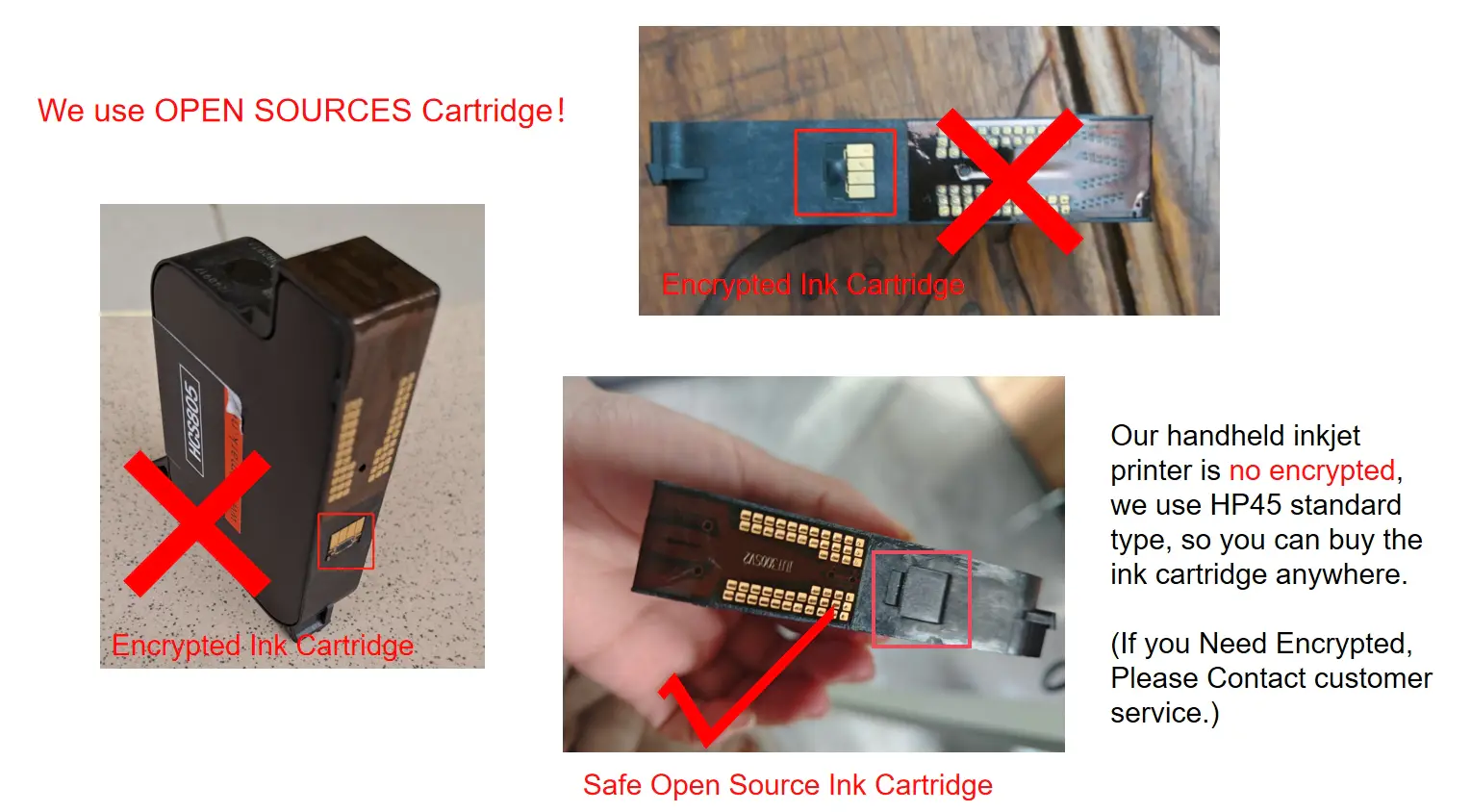
The simplest method is visual. Flip the cartridge over and look at the bottom:
- If you see a small metallic chip embedded in the plastic, the cartridge is encrypted. You are locked to that brand.
- If the bottom is clean plastic with no chip, the cartridge is unencrypted. It works in any compatible printer.
The functional test confirms it:
- Remove the ink cartridge from the printer.
- Turn the printer on.
- Try to "print" in the air by pulling the trigger.
- Watch the counter on the screen. If the counter number increases, the printer does not check for a chip; it is unencrypted. If the counter stays frozen, the printer is encrypted.
MobileMarking printers use unencrypted cartridges with no crypto chip. You can use our new original cartridges at ~$50 each (including shipping), or you can use compatible cartridges from any supplier. We sell cartridges at a fair price because we want you to keep using the printer, not because we have locked you in.
For a complete breakdown of how cartridge encryption works, which handheld brands lock you in, and the regulatory landscape (including Canon's 2022 admission that DRM chips serve no quality purpose), read our deep dive: What Is an Unencrypted Ink Cartridge?.
Three-Year Cost Comparison: All Scenarios
Even the mid-range scenario, a MobileMarking printer with new original cartridges, saves nearly $2,000 over three years compared to an encrypted competitor. If you use remanufactured cartridges in an unencrypted printer, the savings exceed $3,700.
Browse unencrypted ink cartridges →
Handheld vs Industrial Printers: The Real Cost Comparison
If you are comparing a handheld inkjet printer against an industrial CIJ system, the decision comes down to volume and budget. Here are the numbers:
If you're comparing a handheld printer against an industrial production-line system, our batch coding machine buyer's guide breaks down real prices and 3-year costs across all five machine types — handheld TIJ, semi-auto, TTO, CIJ, and laser.
When a handheld printer makes sense:
- You print fewer than 5,000 items per day.
- Your products vary in size and shape, they won't fit neatly on a conveyor.
- You need to print in different locations (warehouse, production floor, job site).
- Your budget is under $5,000 total.
The hidden cost of pre-printed packaging. Many businesses still order boxes and labels pre-printed with dates or batch codes from a central print shop. The problem: you have to guess how many of each variant you will need. Order too few, and the line stops waiting for boxes. Order too many, and you throw away unused packaging when the date changes or the customer updates their spec. On-demand printing with a handheld inkjet printer eliminates this, you print exactly what you need, when you need it, on blank stock. A USDA report on fresh produce packing noted that handheld inkjet printers are available for field-packed carton marking, but adoption has been slowed by equipment cost, a barrier that a $139 printer directly addresses.
Why traceability matters. In food, beverage, and pharmaceutical production, the difference between a precise batch code and a missing one is the difference between recalling a single lot and recalling everything. Handheld printers print lot codes, production dates, and batch numbers in real time at the point of packing, no offline batching, no mismatched labels. For small producers (craft breweries, bakeries, meat and dairy processors, co-packers) who run multiple SKUs in short runs, this means every box, bag, or bottle carries an accurate, scannable code that links back to a specific production batch.
When to step up to CIJ:
- You print 10,000+ identical items per day on a fast-moving line.
- Downtime costs more than the price of the printer.
- You need print speeds above 70 meters per minute.
- You have dedicated operators and a maintenance budget.
For most small and medium manufacturers, the handheld TIJ printer isn't the compromise option, it's the smart option. It costs 2-5% of what a CIJ line costs and handles the same materials.
Mike runs a 15-person metal fabrication shop in Ohio. His biggest customer started requiring batch codes on every bracket and plate that left the shop. He got a quote for a CIJ system: $18,000 installed, plus a $400/month maintenance contract. He bought a Model 1680 industrial handheld printer for $299 instead. "It paid for itself the first morning," he said. Sixteen months later, he has bought a second one for the other end of the shop and still hasn't spent what the CIJ would have cost in year one.
How to Choose the Right Handheld Inkjet Printer
Walk through this decision sequence:
Luis runs a craft brewery in San Diego. He prints expiry dates on 300-400 cans per day, too many for a label gun, too few for automated equipment. He bought a Model 127A for $139, tested it on three different can finishes to find the right ink, and now prints a full day's run in under an hour. The cartridge lasts him six weeks. "I was about to buy a $4,000 semi-automatic system," he said. "Glad I tried the handheld first."
Quick Recommendations by Use Case
Get the Right Printer Without the Hidden Costs
You walked into this guide looking for a handheld inkjet printer that fits your workflow and budget. Here is what actually matters:
Sarah, from the beginning of this guide, switched to an unencrypted printer with new original cartridges. Her annual ink cost dropped from $2,400 to $1,000. She bought a second printer with the savings and still came out ahead. That is the difference between knowing about cartridge encryption and walking into it blind.
Need help picking the right model for your specific material? Contact us, tell us what you are printing on, and we will recommend the correct printer and ink combination. No obligation, no sales pitch.
Browse handheld inkjet printers →
Frequently Asked Questions
What is the best handheld inkjet printer?
There is no single best, it depends on what you print on and how much volume you do. For most small businesses printing dates and batch codes on boxes, an entry-level 600 DPI TIJ printer like the Model 127A is the most cost-effective choice. For wider prints or industrial environments, step up to the 1691S or 1680.
How much does a handheld inkjet printer cost?
Entry-level models start at $139. Mid-range models with wider print heads cost $199-$299. Industrial-grade handheld printers with metal bodies and extended batteries run $300-$500. Compared to a $15,000 CIJ line, the entire handheld category is the affordable option.
Can handheld printers print on curved surfaces?
Yes, within limits. A curved bottle or pipe is fine as long as the curve is not so sharp that the printhead loses contact with the surface. Printers with a 12.7mm print height handle tighter curves better than wide-format models. For best results on curved surfaces, use a printer with a narrow printhead and move your hand smoothly and consistently.
How long does an ink cartridge last?
A standard 42ml cartridge prints roughly 100,000 characters. For a typical date code of 15 characters, that's about 6,600 prints. Heavy daily use goes through 1-2 cartridges per month. Light occasional use may stretch one cartridge for 3-6 months.
Are handheld printer cartridges interchangeable between brands?
Usually not. Each brand uses its own cartridge form factor. Some brands add crypto chips to prevent third-party cartridges from working. Check for encryption before buying: flip the cartridge over and look for a metal chip on the bottom. If there is no chip, the printer is unencrypted and you can buy cartridges from any supplier, remanufactured ($20), new original ($50), or compatible alternatives, instead of being locked to one brand at $80+.
Do I need date codes for regulatory compliance?
It depends on your market. In the U. S., food date labels (except infant formula) are not federally required, most dates indicate quality, not safety (see FSIS guidance on food product dating). However, both FDA and USDA now recommend the voluntary "Best if Used By" phrase to reduce consumer confusion and food waste (see FDA/USDA joint announcement). In the EU, date marking is mandatory for pre-packaged foods under Regulation (EU) No 1169/2011. Even when not required, most retailers and distributors demand lot codes and date stamps, a handheld printer handles this easily.
What's the difference between TIJ and CIJ printers?
TIJ (Thermal Inkjet) uses disposable printhead cartridges, costs $200-$500, and is handheld. CIJ (Continuous Inkjet) uses a recirculating ink system with pumps and solvent, costs $10,000+, and is a fixed production-line machine. TIJ is the right choice for most businesses printing fewer than 5,000 items per day. CIJ is for high-speed, high-volume lines.