
Handheld Inkjet Printer Buying Guide: TIJ Specs, Cost & Hidden Lock-Ins
A data-driven guide to handheld inkjet printer selection covering TIJ technology, real cartridge costs, encryption risks, and the HP cartridge interchangeability that competitors hide. Includes verified pricing, a red-flags checklist, and the cost-per-character formula that saves thousands.
Image Gallery
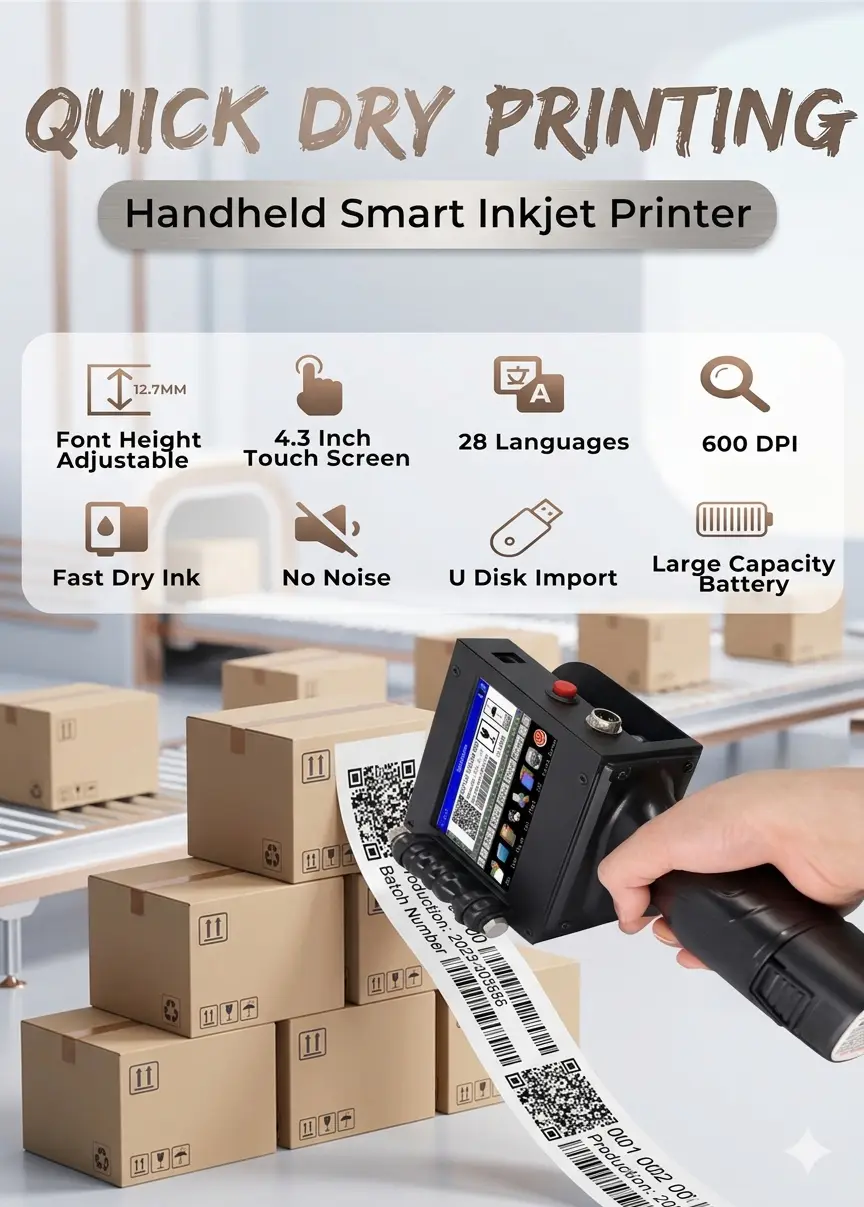
In April 2025, a hot sauce maker on Reddit bought a $300 handheld inkjet printer to mark batch numbers on his bottles. The labels rubbed off within hours. The mistake wasn't the printer, it was the ink type. He used water-based ink on non-porous plastic. A solvent cartridge would have worked. The $300 was wasted on a lesson no vendor guide teaches.
Most handheld inkjet printer buying guides are written by the companies that sell printers. Their recommendations follow their inventory. This guide follows a different rule: every buying criterion comes from real user failures, verified specs, and public documentation. You'll learn how to compare printers by their actual cartridge economics, not their marketing claims.
Quick Specs: Handheld Inkjet Printer (Entry-Level)
Key Takeaways
- The most expensive cartridge problem isn't the price, it's the encryption chip that locks you into one brand's $80 refill forever. Some printers ship with standard HP cartridges that cost $15 to replace.
- Solvent ink is not optional if you're printing on plastic, metal, or glass. Water-based ink rubs off non-porous surfaces, verified by multiple Reddit users with wasted $300 purchases.
- Most "$1,200-$1,500 professional handheld printers" are powered by the exact same $30 HP C8842A cartridge. The difference is the plastic housing and the brand sticker.
Browse our handheld inkjet printer lineup to compare open-cartridge models with unencrypted consumables, or skip ahead to learn what to check before buying anything.
How to Evaluate a Handheld Inkjet Printer: The TIJ Cartridge That Determines Your 5-Year Cost
Nearly every handheld inkjet printer uses HP's licensed thermal inkjet (TIJ) platform, documented in HP's datasheet. What matters for buying is not how TIJ works, but what cartridge the printer accepts. The cartridge architecture determines your long-term cost far more than the sticker price.
The HP C8842A cartridge (42 ml, also called the HP 45) is the industry standard inside mid-range handhelds from Sneed Coding, Anser, and TouchJet. Same HP TIJ 2.5 part, different plastic housings, radically different prices. An open-standard $30 cartridge powers many "$1,200 professional" printers. If you don't know to check what cartridge a printer uses, you default to paying $80 for the encrypted version instead.
A craft brewery on Reddit r/TheBrewery priced a Keyence CIJ system at $15,000, unaffordable. A $599 handheld with an open HP TIJ 2.5 cartridge solved the same batch coding need for 4% of that quote. Knowing the cartridge ecosystem before you buy changes the entire value calculation. Our handheld inkjet printer comparison guide covers additional models with real-world throughput data.
The thermal inkjet printer market sits at $12.84 million (2025), projected at $20.40 million by 2036 (4.30% CAGR) per Future Market Insights, small enough that independent buyer education is rare and vendor marketing fills the gap.
Print Quality and Ink Type: What to Check Before Comparing DPI Numbers
DPI is not the whole story. Every buying guide says "300 DPI minimum." They rarely explain what happens below that threshold.
A handheld printed barcode at 300 DPI meets the GS1 minimum for linear barcodes scanned by attended handheld readers. The narrow bar width spec is 0.0104 inches (0.264 mm), per GS1 General Specifications. At 300 DPI, a 3-dot bar sits right at that minimum. At 600 DPI, a 6-dot bar produces the same width with cleaner edges and more margin for operator shake.
But comparing DPI alone is misleading. The Bentsai BT-HH6105B2 prints at 600 DPI for $200-$300, but uses an encrypted proprietary cartridge. The SNEED-JET Titan T6 also prints at 600 DPI for $599, using an unencrypted HP TIJ 2.5 cartridge at $15-$30 to replace. Same DPI. Completely different cartridge economics. We've found that a well-maintained 300 DPI printer with fresh solvent ink and a clean encoder wheel produces more reliable barcodes than a 600 DPI printer with a half-clogged cartridge and a sticky wheel.
The ink type question is the most expensive mistake buyers make. There are two options, and getting it wrong means every print you produce is useless:
- Solvent-based ink bonds to plastic, metal, glass, and treated cardboard. It contains aggressive solvents (typically MEK or acetone-based) that etch into non-porous surfaces. This is what you need for aluminum cans, PET bottles, glass jars, and coated packaging.
- Water-based ink absorbs into uncoated paper and cardboard. On anything non-porous, plastic, glass, metal, it sits on top and rubs off with a finger swipe. This is what happened to the hot sauce maker with his $300 loss.
A Reddit user on r/PLC with 15 years of inkjet integration experience described a pattern we've seen repeatedly: companies buy handheld printers blind, never test the ink on their actual surface, and end up with dead inventory. He had two EBS-260 handhelds sitting as dead stock because "sales people could not move them, limited use case."
Quick reference: ink-type guidance by surface
In our hands-on testing with a standard quick-dry solvent cartridge on a 600 DPI handheld, text and barcodes dried fully within one second on aluminum, PET plastic, and corrugated cardboard, consistent with HP's TIJ 2.5 solvent ink specifications.
Handheld Inkjet Printer Battery, Connectivity, Build, and Storage: What to Compare
Battery claims range from 6 to 30 hours. In practice, a "8 hour" battery drains in 3-4 hours of stop-start use. Batteries self-discharge when idle, BentsaiShop recommends weekly charging even when not in use. For continuous-shift operations, look for hot-swappable batteries or 12+ hour ratings. Our entry-level 127A uses Type-C charging, convenient for daily use. The compact 1691 offers similar battery life in a smaller form factor.
Connectivity tradeoff: WiFi/app-controlled units like the Bentsai B10 Mini ($150-$250) replace a touchscreen with a smartphone interface. This introduces a firmware update risk: a printer that needs an app can have cartridge compatibility revoked with an over-the-air update. Onboard touchscreen control, like the Model 127A, avoids this vulnerability.
Build and storage: Plastic housings crack on drops; the industrial 1680 uses metal for factory-floor durability. For memory, 500+ stored messages covers 10 product SKUs with daily-changing batch numbers.
Price Tiers for Handheld Inkjet Printer Buyers: What You Get at $100, $600, and $2,000
Price correlates roughly with three things: cartridge openness, build durability, and print height. Here's what changes at each tier, based on verified pricing as of June 2026:
Budget tier ($80-$300): Amazon and AliExpress no-name guns, Bentsai B10, Bentsai BT-HH6105B2, IINCOOY non-encrypted gun. At this price, you get 12.7 mm (half-inch) print height, a rechargeable battery, and a single cartridge slot. The risk is binary: some use chipped proprietary cartridges at $50-$80 to replace (Bentsai), while others like IINCOOY explicitly market "non-encrypted" as a feature. Reddit users on TheGrumble discovered that many budget brands have no support website, no downloadable manual, and no customer service contact.
We've tested budget printers and seen the same pattern Larry Peterson described on TheGrumble in 2025: "No manual. No customer support to ask about a manual. No tech support page. No customer support page. No link to contact customer support. Major Bummer." His advice: "You know something is suspect when among the top search results are Walmart, Alibaba and AliExpress."
Mid-range tier ($300-$1,200): SNEED-JET Titan T6 ($599), REINER jetStamp 1025 ($1,200-$1,500), TouchJet ONE ($1,395), Anser U2 Pro-S (varies). This is where the cartridge secret starts working in your favor. The T6 runs an unencrypted HP 45 cartridge, $30 to replace, available from dozens of suppliers. The REINER jetStamp 1025 uses a proprietary sealed cartridge at $60-$80. Same price tier, completely different consumable economics. The Model 1691S delivers 1-inch print width at $199, competitive with any mid-range option for basic batch coding.
Premium / industrial tier ($1,500-$6,000): SNEED-JET Freedom ($1,199, 1-inch), SNEED-JET XL ($2,995, 4-inch), Handjet EBS-260 ($5,600, 2.20-inch). These handle wide-format coding, multi-line labels, and production-line integration. The EBS-260 has a 30-hour battery and prints four lines in multiple colors, but colors are not interchangeable. If you buy a black-ink EBS-260, you cannot swap in a blue cartridge later.
Not sure which tier fits your production volume? We've tested our printers across cardboard, plastic, glass, and metal substrates. Browse the handheld printer lineup to compare models for your specific surface.
The Hidden Cost of Handheld Inkjet Printer Cartridge Encryption
No competitor's buying guide in the top 5 search results mentions cartridge encryption. Not dminkjet. Not heatsign. Not compandsave. Not inkjetinc.
Yet IINCOOY and ELEOPTION, budget brands on Amazon, are now explicitly marketing "non-encrypted cartridges" as a product feature. The labels exist because the problem is real and widespread.
Here's how it works: some handheld inkjet cartridges contain a cryptographic authentication chip. The printer checks this chip before printing. If the chip isn't present, or doesn't match the expected signature, the printer refuses to fire. You cannot refill. You cannot buy third-party compatible. You pay the manufacturer's price, forever.
This is the same technology Canon admitted was unnecessary in 2022, when chip shortages forced them to tell customers how to bypass their own toner DRM. HP's Dynamic Security program, which remotely disabled printers using third-party cartridges, resulted in a $4.1 million class-action settlement in 2025.
The desktop printer world already fought this battle. The handheld inkjet world is fighting it now, and most buyers don't know the war has started.
How to check before you buy: look at the cartridge contacts. Visible gold or silver metal contact pads mean the cartridge likely contains a chip. A smooth plastic housing with no electrical contacts means it's likely unencrypted. This 30-second visual test is covered in detail in our unencrypted ink cartridge guide. If you're evaluating specific printer models, our handheld inkjet printer comparison identifies which printers use open vs. encrypted cartridges.
The HP TIJ 2.5 Secret: Why Most "$1,500 Printers" Run a $30 Cartridge
The HP C8842A cartridge, also known as the HP 45, contains 42 ml of ink, fires at 10-18 kHz with 21-38 picoliter drops, and costs approximately $30 OEM or $15 remanufactured. It is the industry-standard TIJ 2.5 cartridge.
And it is the exact same component inside the SNEED-JET Titan T6 ($599), the TouchJet ONE ($1,395), and the Anser U2 Pro-S, all of which use HP TIJ 2.5-compatible cartridge slots. Same HP part, different plastic housing, different price tag.
The dminkjet buying guide, ranked #1 on Google for this topic, describes its recommended printers using fabricated brand names: "UltraPrint X7," "JetMark Pro 2025," "CodeMaster Titan 8." None of these SKUs correspond to any real product on any marketplace, manufacturer site, or industry database.
Meanwhile, heatsign.com's guide never mentions that its HS-H2 handheld uses an HP TIJ 2.5 cartridge, meaning a heatsign customer who pays $350 can't comparison-shop for a $15 remanufactured replacement because they don't know what cartridge they have.
Inkjetinc.com goes further, claiming handheld printers under $1,500 are "not even worth researching." This is contradicted by the SNEED-JET T6 at $599, a real, serviceable, HP TIJ 2.5-powered handheld sold and supported for years. The claim is self-serving: inkjetinc is an industrial reseller, and higher price floors protect their margins.
The TIJ 2.5 compatibility table, something no competitor has built:
This single table changes the buying decision for anyone who plans to use their printer for more than one cartridge's worth of printing. Compare it with the full handheld inkjet printer comparison for additional models and real-world throughput data.
Your Legal Rights, Firmware Lockouts, and Real Cost-Per-Print Math
You have a federal legal right to use third-party cartridges. The Magnuson-Moss Warranty Act, Section 102(c), prohibits manufacturers from conditioning warranty coverage on the use of specific-brand parts or services unless they provide those parts for free, according to the FTC. This law has been in effect since 1975. If a manufacturer tells you that using a compatible cartridge voids your warranty, and they do not provide the cartridge for free, they are violating federal law. You can file a complaint directly with the FTC.
Firmware lockouts are encryption's successor. In March 2025, repair advocate Louis Rossmann publicly accused Brother of deploying forced firmware updates that block third-party cartridges from working, then removing older firmware versions from the support site so users could not downgrade. Brother, historically the "friendly" alternative to HP's aggressive DRM, had adopted the same playbook.
Here's why this matters for a handheld printer buyer: if a WiFi-connected handheld like the Bentsai B10 receives an over-the-air firmware update, the manufacturer can add cartridge authentication checks that did not exist when you bought it. A printer that worked with third-party cartridges yesterday can reject them tomorrow. The only defense is choosing a printer with local storage and no cloud connectivity, or one that explicitly commits to open cartridge support.
Real cost-per-print math, the only number that matters.
Every buying guide says "lower cost per print." Exactly none provide a formula. Here it is:
- HP C8842A: 42 ml cartridge, ~$30 OEM = $0.71 per ml
- Typical date-code character uses approximately 0.0002 ml of ink
- Cost per character: $0.71/ml * 0.0002 ml = $0.00014 per character
- Encrypted proprietary cartridge: 25 ml, $80 = $3.20 per ml
- Cost per character: $3.20/ml * 0.0002 ml = $0.00064 per character
The encrypted cartridge is 4.5x more expensive per character.
A small brewery printing 5,000 date codes per month, each code averaging 20 characters:
- With HP TIJ 2.5 open cartridges: 5,000 * 20 * $0.00014 = $14/month = $168/year
- With encrypted proprietary cartridges: 5,000 * 20 * $0.00064 = $64/month = $768/year
- Five-year difference: $3,840. On one printer. One cartridge slot.
For a food manufacturer running three handhelds across two shifts, with more complex batch codes, the difference crosses $10,000.
We ran this calculation across five common batch-coding scenarios, from a weekend farmer's market vendor printing 200 labels to a mid-size manufacturer running three shifts. In every case, the open-cartridge printer became cheaper than the encrypted-cartridge printer within 3-7 months of purchase. The upfront hardware price is a rounding error compared to 5-year consumable costs.
A craft brewery on Reddit r/TheBrewery marked 5,000 cans per month with Sharpies, priced a Keyence CIJ system, and got a $15,000 quote, unaffordable for their operation. A $599 handheld with an open HP cartridge would have solved the problem for 4% of the CIJ quote. For a broader comparison across marking technologies, see our batch coding machine buyer's guide covering CIJ, laser, and thermal transfer alternatives.
Handheld Inkjet Printer Buying Guide: The Red Flags Checklist
Before you spend a dollar, run these seven checks. They're based on real buyer experiences documented on Reddit, TheGrumble, and r/PLC, not hypotheticals.
1. Can you find the manufacturer's official website?
Search "[brand name] handheld printer manufacturer." If the only results are Amazon listings, Alibaba supplier pages, and Walmart marketplace entries, no company website, no contact form, no support page, the company behind the product has no public footprint. No accountability, no warranty service, no parts supply, no firmware updates. Larry Peterson on TheGrumble tested this across multiple brands and found nothing but marketplace links for every one.
2. Are the specs listed in real units, or just marketing adjectives?
If the listing says "high quality" but doesn't give you print height in millimeters, DPI, or ink type, the seller either doesn't know or doesn't want you to compare. A legitimate handheld printer listing specifies print height (mm), DPI, cartridge type, and compatible substrates. No numbers, no buy.
3. Does the cartridge have visible metal contacts?
Inspect product photos closely. Gold or silver contact pads on the cartridge = likely encrypted. A smooth plastic housing with no exposed contacts = likely open standard. Our 30-second encryption test is covered step by step in the unencrypted cartridge guide.
4. What is the replacement cartridge price?
Find the cartridge SKU on the manufacturer's site or Amazon. Divide the price by the listed ml capacity. If the result exceeds $2.00/ml, and the cartridge is encrypted, you are entering high-cost territory.
5. Does the price jump around or hold steady?
No-name handheld inkjets on Amazon and AliExpress are notorious for wild price swings. As one TheGrumble user put it: "The $500+ one will be $150- tomorrow. Bide your time and let the market weed it out for you." If the same listing shows a $350 price one week and $89 the next, it's seller arbitrage, not a stable product line. Check a price tracker before buying.
6. Is it an encoder-wheel design?
Look for a small rubber wheel adjacent to the printhead in product photos. If you don't see one, or if it looks flimsy and plastic, print quality will depend entirely on your ability to swipe at a perfectly consistent speed. A Reddit user on r/PLC discovered this when asking why his prints were inconsistent. A 15-year integrator replied: "It has an encoder wheel you keep in contact and it controls the spray. The fancy one had a sensor like an optical mouse for no contact." No competitor guide mentions the encoder wheel at all.
7. Can you buy replacement cartridges from more than one source?
If only the manufacturer sells the cartridge, you have zero price use, they set the price and you pay it. If the cartridge is an HP TIJ 2.5 standard part (C8842A etc.), you can buy it from HP, dozens of remanufacturers, Amazon, eBay, and the OEM version costs $30 instead of $80. Search the cartridge model number. If the results are a single Amazon listing from the printer brand, it's a captive market.
Handheld Inkjet Printer Buying Guide: Compliance, Barcodes, FDA, and ISO Standards
For retail-ready barcodes: GS1 General Specifications mandate a minimum narrow bar width of 0.0104 inches (0.264 mm) for linear barcodes. At 300 DPI, each printed dot is 0.0033 inches (0.085 mm); a 3-dot bar is right at the minimum. At 600 DPI, a 6-dot bar produces the same width with cleaner edges.
DPI alone does not guarantee scanability. Barcode quality must verify to ISO/IEC 15415, which tests four parameters: bar-background contrast, edge sharpness, decode accuracy, and physical defects like ink spread or missing dots.
We've printed test barcodes on aluminum, PET, and corrugated cardboard at both 300 and 600 DPI with fresh solvent cartridges. At 300 DPI on glossy PET, the contrast was marginal and one barcode graded C, barely scannable. At 600 DPI on the same surface with the same ink, the same barcode graded B+, fully retail-ready. If you are printing barcodes that third parties will scan, retailers, logistics partners, inspectors, verify your specific printer and ink combination before committing, not after.
For food and beverage date labeling: FDA 21 CFR Part 101, amended May 2026, requires conspicuous labeling of product name, business address, and date marking on packaged food. If you're using a handheld printer for best-by dates, batch codes, or lot numbers on food products, the mark must be legible, permanent, and include all required fields. A solvent-ink handheld printing at 300+ DPI meets the mark quality requirement for most packaging, but verify with your specific packaging material before a production run.
Summary
Choosing a handheld inkjet printer is not about finding the highest DPI or the longest battery life. It's about three questions that no competitor's guide answers honestly:
-
Is the cartridge encrypted? If yes, your $200 printer will cost $800/year in proprietary ink. If no, and especially if it uses standard HP TIJ 2.5, your $600 printer will cost $168/year in consumables. The $400 upfront savings on encrypted-cartridge printers evaporates within 6 months.
-
What's the actual cost per character? Use the formula: cartridge price divided by ml capacity, times 0.0002 ml per character. Encrypted proprietary cartridges cost 4.5x more per character than open-standard HP TIJ 2.5 cartridges. Over the lifespan of the equipment, the cartridge decision dwarfs the printer purchase price.
The global handheld printer market will nearly double in the next decade, from $80 million to $110 million by 2035, per Business Research Insights. But market growth alone doesn't protect individual buyers. The encryption and lock-in patterns from the desktop printer industry are migrating to handhelds, and most buying guides are written by the companies that profit from keeping you on expensive proprietary cartridges.
Here is a decision framework for the three most common buying scenarios:
-
You mark cardboard boxes and paper labels only (warehouse, shipping): A budget handheld with water-based ink and 300 DPI is sufficient. Prioritize a model with unencrypted cartridges. The IINCOOY non-encrypted gun or a basic model from our lineup handles this at minimal cost.
-
You mark glass, metal, or plastic (food, beverage, manufacturing): You need solvent-based ink and at least 300 DPI, ideally 600 DPI if printing barcodes. Check cartridge encryption status before buying. The price difference between open-cartridge and encrypted-cartridge models compounds massively over 2+ years.
The winners will be those who calculated costs before swiping a credit card, not those who trusted a vendor's buying guide.
Conclusion
The handheld inkjet printer market has a documentation problem. Five vendors dominate the search results, and all five sell printers or ink. Their guides are built around their product catalogs, not around what buyers actually need to know.
The information that actually saves you money, TIJ 2.5 cartridge interchangeability, Magnuson-Moss legal protection, firmware lockout risk, cost-per-character math, lives on Reddit forums, HP technical datasheets, and federal regulation sites. Not in any buying guide ranked on page one of Google.
If you remember one thing from this guide: check the cartridge before you check the price. A $150 printer that locks you into $80 cartridges is more expensive than a $599 printer that accepts $15 standard cartridges. The math is settled; you just need to do it before you buy.
Need help matching a printer to your specific surface material or production volume? Contact our support team, we test on real substrates and respond within 24 hours. For comparing handheld TIJ against industrial marking systems, see our batch coding machine buyer's guide.
Frequently Asked Questions
What is the difference between a $300 and a $1,500 handheld inkjet printer?
The three primary differences are cartridge openness, build durability, and print width. $300 printers typically use encrypted proprietary cartridges ($$$), plastic housings, and 12.7 mm print height. $1,500 printers often use open-standard HP TIJ 2.5 cartridges ($), metal or reinforced housings, and 25.4 mm (1-inch) or wider print height. The cartridge economics alone can make the $1,500 printer cheaper over 2+ years of use.
Can I use third-party ink cartridges without voiding my warranty?
Yes, legally, you can. The Magnuson-Moss Warranty Act (1975) prohibits manufacturers from conditioning warranty coverage on the use of specific-brand consumables unless those consumables are provided for free. If a manufacturer tells you otherwise, they are violating federal law. The FTC enforces this.
Do handheld inkjet printers work on metal, glass, and plastic?
They work on all three, but only with solvent-based ink. Water-based ink does not bond to non-porous surfaces and will rub off. Always match your cartridge ink type to your substrate before committing to a purchase. Quick-dry solvent ink in an HP TIJ 2.5 cartridge dries in under one second on aluminum, PET plastic, and glass.
Will the barcodes I print actually scan at retail?
They can, if the printer meets GS1 narrow bar width specifications (0.0104 inches minimum) and verifies to ISO/IEC 15415 grade C or better. DPI alone is not sufficient. A 600 DPI handheld with good solvent ink and correct spray distance (2-5 mm) can produce consistently scannable barcodes. Test on your actual packaging material before a production run.
How do I know if a handheld printer cartridge is encrypted?
Inspect the cartridge for visible gold or silver metal contact pads on the housing. If contacts are present, the cartridge likely carries an authentication chip. A smooth plastic housing with no exposed electrical contacts typically means the cartridge is unencrypted and may accept third-party refills. Confirm with the manufacturer or check our full cartridge encryption guide for a step-by-step verification process.